
Why Islam Can Be Fixed
WITHOUT DESTRUCTION

ALSO SEE:

1. The Possibility of Reform
So I’ve been arguing with people who think that Islam should be destroyed and not reformed. In light of its recent atrocities I understand where they’re coming from but this trauma cramps their metaphysics.
“Kali is both the creator and the destroyer” I tell them, but this Hinduism’s lost on them.
“Whenever Islam is ‘reformed’ it becomes more regressive, not progressive” they tell me, but the past is not what’s possible, and logically, it’s possible, if we assume that holy books are what govern religions:
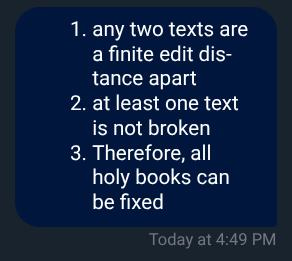
If this is unclear review Edit Distance in Computer Science. I should also say that, due to the books being finite and thus containing at most a finite number of errors, these edits are not just logically possible, but physically possible — even if the edits, for them to stick, must be made by specific players at specific times.
In my original treatment I used the KJV as a text I thought my audience would find comparatively bugless, and said “If you support the Church of England but not Islam, since the Quran could be changed, in a finite number of steps, into the KJV, you must accept that Islam can be reformed.”
“Reforming Islam would destroy it” they insisted.
“That is arbitrary” I insisted — if some future Islam 2.0 is called ‘not equal to’ Islam 1.0 that’s calling it ‘destruction’ and if it’s called ‘equal’ that’s calling it ‘reform’. Did Windows 95 destroy Windows 3.1 or reform it? This is why there are different strengths of equivalence relation in mathematical reality and even as basic operators in programming languages — identity is actually arbitrary.
So, it’s all a manner of speaking or of emphasis:
If I resculpt a statue of a dog into a statue of a cat I have destroyed the ‘dog’ but not the clay, so you can call it what you want, reformation or destruction, since what really matters is the desired shape, not what we say about whether it’s ‘identical’ or not with the old statue. So let’s get sculpting:
2. Constraints On Reform
While this article’s called “Why Islam Can be Fixed” and not “How to Fix Islam In Every Sordid Detail”, and while I will not say precisely how to fix any religion, I will, in addition to the brief proof above of the logical and physical possibility of Islamic reform, provide a few basic constraints on religious reform — some of them will apply to other faiths you may already be familiar with:
holy texts must be revisable (sins are bugs and books have bugs)
human rights must trump religious freedom (so much for childhood circumcision)
all faiths must adopt polytheism, since monotheism is cultural genocide
no god is literal — Religions must be consistent with an atheist scientific worldview
might is not right — Religions must be consistent with anarchism:
On this last point, chatgpt might have been Islamophobic when it told me, back in 2023, that no version of Islam would submit to Anarchism — the moral thesis that power is not self-justifying:
But in this revisionist framework, we’re only a Martin Luther or two away from a new religion at any time (Can you tell I was raised Protestant?) so this AI is really selling the Islamic project short.
(With a return to preabrahamic polytheism, both Arabic and Levantine, we would see a more natural re-emergence of the anarchism of polytheism, I suspect, where one god must somehow justify their power over another, rather than a theology of entrenched power.)
I hesitate to add the sixth condition that comes from combining 1 and 2 above with ACAP, namely, that all religions must be consistent with the moral teachings of Christ, which I believe in and feel in my soul, despite not believing in The Virgin Birth or The Literal Resurrection, because adding such a condition seems culturally imperious…
But this is probably just my latest sin: Can any faith be truly reformed if any one of these teachings is absent?
Name one, name one teaching of Jesus that’s discardable in a perfect religion, I’ll wait…
—
adamgolding.ca
PS what other constraints would you add on religious reform?
I can also offer:
The Noahite Laws under a polytheistic interpretation of idolatry: “DO NOT WORSHIP FALSE IDOLS” — Jealousy is a sin anyway…
PPS the other reason I left out #6 is that the teachings of Christ are already inherent in Anarchism, since Proudhoun was merely translating the theological Christ into political language in coining “Anarchism” — just see how he put it back in 1840:
“All at once a man appeared, calling himself The Word of God. It is not known to this day who he was, whence he came, nor what suggested to him his ideas. He went about proclaiming everywhere that the end of the existing society was at hand, that the world was about to experience a new birth; that the priests were vipers, the lawyers ignoramuses, and the philosophers hypocrites and liars; that master and slave were equals, that usury and every thing akin to it was robbery, that proprietors and idlers would one day burn, while the poor and pure in heart would find a haven of peace.
This man — The Word of God — was denounced and arrested as a public enemy by the priests and the lawyers, who well understood how to induce the people to demand his death. But this judicial murder, though it put the finishing stroke to their crimes, did not destroy the doctrinal seeds which The Word of God had sown. After his death, his original disciples travelled about in all directions, preaching what they called the good news, creating in their turn millions of missionaries; and, when their task seemed to be accomplished, dying by the sword of Roman justice. This persistent agitation, the war of the executioners and martyrs, lasted nearly three centuries, ending in the conversion of the world. Idolatry was destroyed, slavery abolished, dissolution made room for a more austere morality, and the contempt for wealth was sometimes pushed almost to privation. Society was saved by the negation of its own principles, by a revolution in its religion, and by violation of its most sacred rights. In this revolution, the idea of justice spread to an extent that had not before been dreamed of, never to return to its original limits. Heretofore justice had existed only for the masters; it then commenced to exist for the slaves.
Nevertheless, the new religion at that time had borne by no means all its fruits. There was a perceptible improvement of the public morals, and a partial release from oppression; but, other than that, the seeds sown by the Son of Man, having fallen into idolatrous hearts, had produced nothing save innumerable discords and a quasi-poetical mythology. Instead of developing into their practical consequences the principles of morality and government taught by The Word of God, his followers busied themselves in speculations as to his birth, his origin, his person, and his actions; they discussed his parables, and from the conflict of the most extravagant opinions upon unanswerable questions and texts which no one understood, was born theology, — which may be defined as the science of the infinitely absurd.
The truth of Christianity did not survive the age of the apostles; the Gospel, commented upon and symbolized by the Greeks and Latins, loaded with pagan fables, became literally a mass of contradictions; and to this day the reign of the infallible Church has been a long era of darkness. It is said that the gates of hell will not always prevail, that The Word of God will return, and that one day men will know truth and justice; but that will be the death of Greek and Roman Catholicism, just as in the light of science disappeared the caprices of opinion.
The monsters which the successors of the apostles were bent on destroying, frightened for a moment, reappeared gradually, thanks to the crazy fanaticism, and sometimes the deliberate connivance, of priests and theologians. The history of the enfranchisement of the French communes offers constantly the spectacle of the ideas of justice and liberty spreading among the people, in spite of the combined efforts of kings, nobles, and clergy. In the year 1789 of the Christian era, the French nation, divided by caste, poor and oppressed, struggled in the triple net of royal absolutism, the tyranny of nobles and parliaments, and priestly intolerance. There was the right of the king and the right of the priest, the right of the patrician and the right of the plebeian; there were the privileges of birth, province, communes, corporations, and trades; and, at the bottom of all, violence, immorality, and misery. For some time they talked of reformation; those who apparently desired it most favoring it only for their own profit, and the people who were to be the gainers expecting little and saying nothing. For a long time these poor people, either from distrust, incredulity, or despair, hesitated to ask for their rights: it is said that the habit of serving had taken the courage away from those old communes, which in the middle ages were so bold.
Finally a book appeared, summing up the whole matter in these two propositions: What is thee third estate? — Nothing. What ought it to be? — Every thing. Some one added by way of comment: What is the king? — The servant of the people.
This was a sudden revelation: the veil was torn aside, a thick bandage fell from all eyes. The people commenced to reason thus:—
If the king is our servant, he ought to report to us;
If he ought to report to us, he is subject to control;
If he can be controlled, he is responsible;
If he is responsible, he is punishable;
If he is punishable, he ought to be punished according to his merits;
If he ought to be punished according to his merits, he can be punished with death.”